
By Auke van Geene, MA, winner IASPM Benelux MA thesis prize 2025
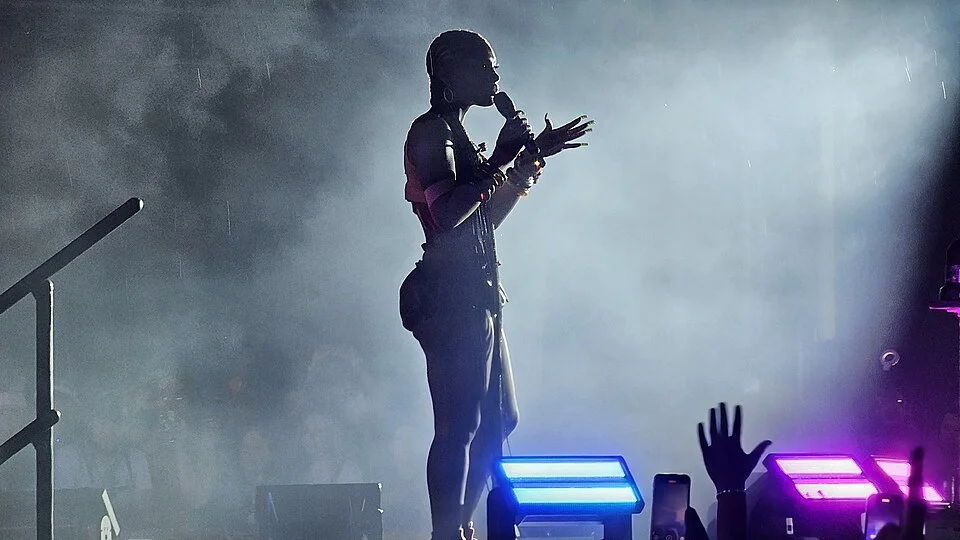
Doechii arrives vividly in our ears, on our screens, each time we watch her celebrated YouTube performance on NPR Music’s Tiny Desk series (2024). Here she is, together with her magnificent ten-headed, all-women-of-colour ensemble. The video is an intimate, acoustic chapter of her grammy-award winning project Alligator Bites Never Heal (2024).
Towards the end of the concert, the ensemble performs ‘Black Girl Memoir’ (NPR, 2024, 17:00). The song gives tribute to Doechii’s experience of Black girlhood, and radiates with her insistence on resilience and confidence within/despite the violence of our anti-Black world that she experiences. Beforehand, Doechii notes:
I decided to perform this record because I think there have been a lot of heightened emotions with the current state of our country. And I wrote this song specifically for Black women […] So I dedicate this to all the beautiful Black women in the room. [applause]
‘Black Girl Memoir’, then, is, in the first place, not addressed to white listeners, including myself. Yet, I found myself watching Doechii’s Tiny Desk for the first time with some of my white, queer, Dutch friends. We were all over the moon about it. However, this made me wonder: what does it mean that we are ‘listening in’ on Hip Hop’s embodied resistance? What is happening in the social dimension of race in this encounter? Are we not easily consuming Doechii’s spectacular performance from the comfort of our self-evidently safe white student lives, without being interested in what she has to say? Can we become aware of how our positioning as white people shapes our listening, and what it might obstruct us from hearing?
My master’s thesis in Comparative Cultural Analysis evolved into a project centred around this questioning of our ordinary listening to Doechii. With five of my friends, we organised listening-reflection sessions centred around her Tiny Desk concert. In it, we opened a vulnerable space to critically interrogate how we reproduce systemic racism through our engagement with Hip Hop.
Becoming aware that race shapes our cultural interactions is already quite something, especially in the Netherlands. As Gloria Wekker shows us in her seminal work White Innocence (2016), white people are taught to believe that we are innocent and free of racism. In Western dominant narratives, whiteness constantly makes itself invisible as the norm. Therefore, we don’t question how systemic racism shapes how we listen to Hip Hop altogether. Or, in the case of leftist or ‘progressive’ white Dutch people, we might even pat ourselves on the back because we believe our listening to ‘conscious’ or ‘feminist’ rap makes us anti-racists.
Instead, we need to come to terms with the fact that we have been taught to listen with ‘white ears’ which distort and devalue Black people’s voices (Stoever, 2016; Robinson, 2020). Our cultural frame of reference, and what Wekker calls our ‘cultural archive’, emerges from a history of four hundred years of Dutch slavery and colonialism (2016, p. 2). These patterns of meaning-making live inside each of us and make us see Black Hip Hop artists as Other. These frames enable us to see Blackness as a spectacle for our own enjoyment (Martina, 2013). With ‘white ears’, for example, we understand Hip Hop through the lens of sensational stories of Black trauma, of noise and Black anger, or of exotic hypersexuality. Us, queer students of the radical left, also reproduce these patterns constantly. And our racist-capitalist world keeps pushing us to consume Black music in this way, rather than to listen to the radical critique that Hip Hop offers.
Because white modes of consuming Blackness are so deeply embedded, listening to Doechii might seem like an impossibility. Yet, truly listening to those who have been made Other is key to unsettling this modern-colonial order (Vázquez, 2012). Does the dominance of whiteness not also contain cracks and gaps? When we engage with Hip Hop, we can’t deny it touches us, moves us. For example, my friend Jip (pseudonym) reflected on what Doechii had made her understand and feel:
‘Black Girl Memoir’, I think, also revolved a lot around trauma, and […] that something exists after trauma. While watching, I often recognised that positivity and solidarity. […] I feel very light now, I hadn't noticed that yet. I think ‘moved’ is a really good word, because I feel energy.
If we allow ourselves to be moved in our feelings and body, if we allow Doechii’s songs to let us see the world from her perspective, can ordinary listening not also hold the potential to transform us? Can we attend to the resistance and resilience that travels through the pulse, rhythm and lyrics of Hip Hop (Seth, 2023)? Can we start to hear the depths of Black feminist music’s revolutionary critique (Brooks, 2021)?
To find those moments of listening, of being moved, however, we need to dare to step out of our safe place of comfort as white people, where Blackness remains a spectacle. It demands of us that we reckon with our own relation to the history of slavery and colonialism and to the reproduction of systemic racism today. This listening requires a continuous reflexivity and attendance to our programmed ways of consuming. With our project, we have tried to make a start. And luckily, Doechii’s brilliant artistry continues to call on us to keep listening.
About the author
Auke van Geene is a student, writer, activist, and organiser. Their work brings into conversation decolonial theory, whiteness studies, and queer studies, where they are especially interested in processes of confronting and unlearning coloniality and Dutch white innocence in everyday life. They co-organise grassroots political education initiatives like Gemiste Geschiedenissen and Dekoloniale Werkweek Utrecht. Holding a bachelor’s degree in History and Postcolonial Studies at Utrecht University and a master’s degree in Comparative Cultural Analysis at the University of Amsterdam, they are currently taking courses in African Feminist Studies at the University of Cape Town. You can reach them via auke.vangeene@protonmail.com or follow their projects via @auke.vangeene on Instagram.
Contact information: auke.vangeene@protonmail.com
Short bibliography
Brooks, D. A. (2021). Liner notes for the revolution: The intellectual life of Black feminist sound. Cambridge: Harvard University Press.
Doechii. (2024, August 30). Alligator Bites Never Heal [Album].
Top Dawg Entertainment/Capitol Records. Soundcloud. https://soundcloud.com/iam-doechii/sets/alligator-bites-never-heal
Martina, E. A. (2013, October 15). The delicious pleasures of racism. Processed Life. https://processedlives.wordpress.com/2013/10/15/the-delicious-pleasures-of-racism/
NPR Music. (2024, December 6). Doechii: Tiny desk concert [Video]. YouTube. https://www.youtube.com/watch?v=-91vymvIH0c
Robinson, D. (2020). Hungry Listening: Resonant Theory for Indigenous Sound Studies. University of Minnesota Press.
Seth, P. J. (2023). The first time I heard: Black feminist approaches to Hip Hop methodologies. Cultural Studies ↔ Critical Methodologies, 23(5), 427–436. doi: 10.1177/15327086231186593
Stoever, J. L. (2016). The sonic color line: Race and the cultural politics of listening. New York: NYU Press.
Vázquez, R. (2012). Towards a Decolonial Critique of Modernity: Buen Vivir, Relationality and the Task of Listening. In R. Fornet-Betancourt (Ed.), Capital, Poverty, Development (pp. 241–252). Mainz.
Wekker, G. (2016). White innocence: Paradoxes of colonialism and race. Durham: Duke University Press.